Resilience through Innovation & Sustainability
📍 Szczecin, Poland | 28 September – 2 October 2026 / Hosted by Liceum Plastyczne im. Constantina Brancusiego
📌 Executive Summary
The fourth transnational meeting of the Erasmus+ ARTisGReen project took place in Szczecin, Poland, from 28 September to 2 October 2026, hosted by the Państwowe Liceum Sztuk Plastycznych im. Constantina Brancusiego. The meeting brought together students and teachers from all six partner countries: Greece 🇬🇷, Romania 🇷🇴, Türkiye 🇹🇷, Poland 🇵🇱, Portugal 🇵🇹, and Estonia 🇪🇪.
The Polish mobility was implemented within Work Package 3 – Creating Synergies in Art for Wellbeing and Inclusion, building upon the foundational work completed during the Greek, Portuguese, and Romanian mobilities. The programme focused on finalising the Green Plan, advancing eco-friendly practices across partner organisations, and creating synergies between Arts, Science, and the natural environment.
RTIS Network participated actively through its collaborating partner, the 4th Lyceum of Alimos, demonstrating its continued commitment as one of the project’s most engaged partners.
🎯 Objectives of the Polish Mobility
The 4th Transnational Meeting was designed to achieve the following objectives, aligned with the ARTisGReen project’s stated goals :
| Objective | Description |
|---|---|
| O1 | Develop a strategy to integrate sustainability in daily living and teaching/training practices within partner organisations |
| O2 | Develop key competencies among participating students and educators |
| O3 | Develop new teaching/learning methods based on interdisciplinarity, integration of STEAM practices, and synergies between different Arts and education providers |
| O4 | Increase by 50% the number of students from vulnerable groups involved in eco-friendly activities |
The mobility specifically addressed the project’s need to train educators in incorporating sustainability into traditional and digital arts while maintaining a balance between technical and creative aspects of artistic education.
📅 Day 1 Report | Monday, 28 September 2026
Programme Deliverable: A.3.2 Student Mobility in Poland – Opening Day
Morning Session | City Scavenger Hunt: “Green City, Creative Minds”
| Time | Activity |
|---|---|
| 09:00 | Meet at the Ibis Hotel |
| 09:30 – 11:30 | City Scavenger Hunt: “Green City, Creative Minds” |
The opening day commenced with a structured city scavenger hunt designed to orient participants within Szczecin while emphasising environmental awareness. The activity, titled “Green City, Creative Minds,” required students to explore the city’s green spaces, sustainable infrastructure, and cultural landmarks through a series of problem-solving tasks.
Learning Outcomes:
- Orientation within the host city
- Team building across nationalities
- Environmental awareness of urban sustainability
- Creative problem-solving and communication skills
Midday Session | Welcome at the Host School
| Time | Activity |
|---|---|
| 12:00 | Welcome for project participants – School tour |
| 13:00 – 14:00 | Lunch |
Participants were formally welcomed at Liceum Plastyczne im. Constantina Brancusiego, a school with a distinguished history dating back to 1948, located at the foot of the Pomeranian Dukes’ Castle in the historic Loitz tenement house. The school offers a five-year educational cycle in artistic specialisations including design, restoration, and graphic techniques .
The school tour introduced participants to the institution’s facilities, workshops, and exhibition spaces. Students were subsequently assigned to international working groups, ensuring balanced representation from all six partner countries for the week’s collaborative activities.
Afternoon Session | Youth Workshops: Bioplastics, Cyanotype & Linocut
| Time | Activity |
|---|---|
| 14:00 – 16:00 | Youth Workshops (two rotating groups) |
| 16:00 onwards | Free time |
| 19:00 | Dinner for teachers at “Baraz” restaurant |
The first workshops introduced three distinct techniques with strong connections to sustainability and artistic innovation:
🌱 Bioplastics Workshop
Participants explored the production and application of biodegradable materials derived from renewable sources. This workshop directly supported the project’s objective of integrating circular economy principles into artistic practice.
🔵 Cyanotype Workshop
The historic photographic printing process using light-sensitive chemistry and sunlight was introduced. Students created distinctive blue-toned images, connecting artistic heritage with sustainable, low-impact creative practices.
🖨️ Linocut Workshop
The traditional relief printing technique was taught, requiring precision, patience, and creative planning. This workshop reinforced the balance between technical skill and creative expression central to ARTisGReen’s pedagogical approach.
Student Diaries & Reflection
As per project deliverables, students recorded their reflections in daily diaries, capturing their initial impressions of Szczecin, their workshop experiences, and their expectations for the week ahead.
📅 Day 2 Report | Tuesday, 29 September 2026
Programme Deliverable: A.3.2 Student Mobility in Poland – Environmental Immersion
Full-Day Excursion | Międzyzdroje & Wolin National Park
| Time | Activity |
|---|---|
| 07:30 | Departure for Międzyzdroje |
| Morning | Visit to the Natural History Museum & Workshops |
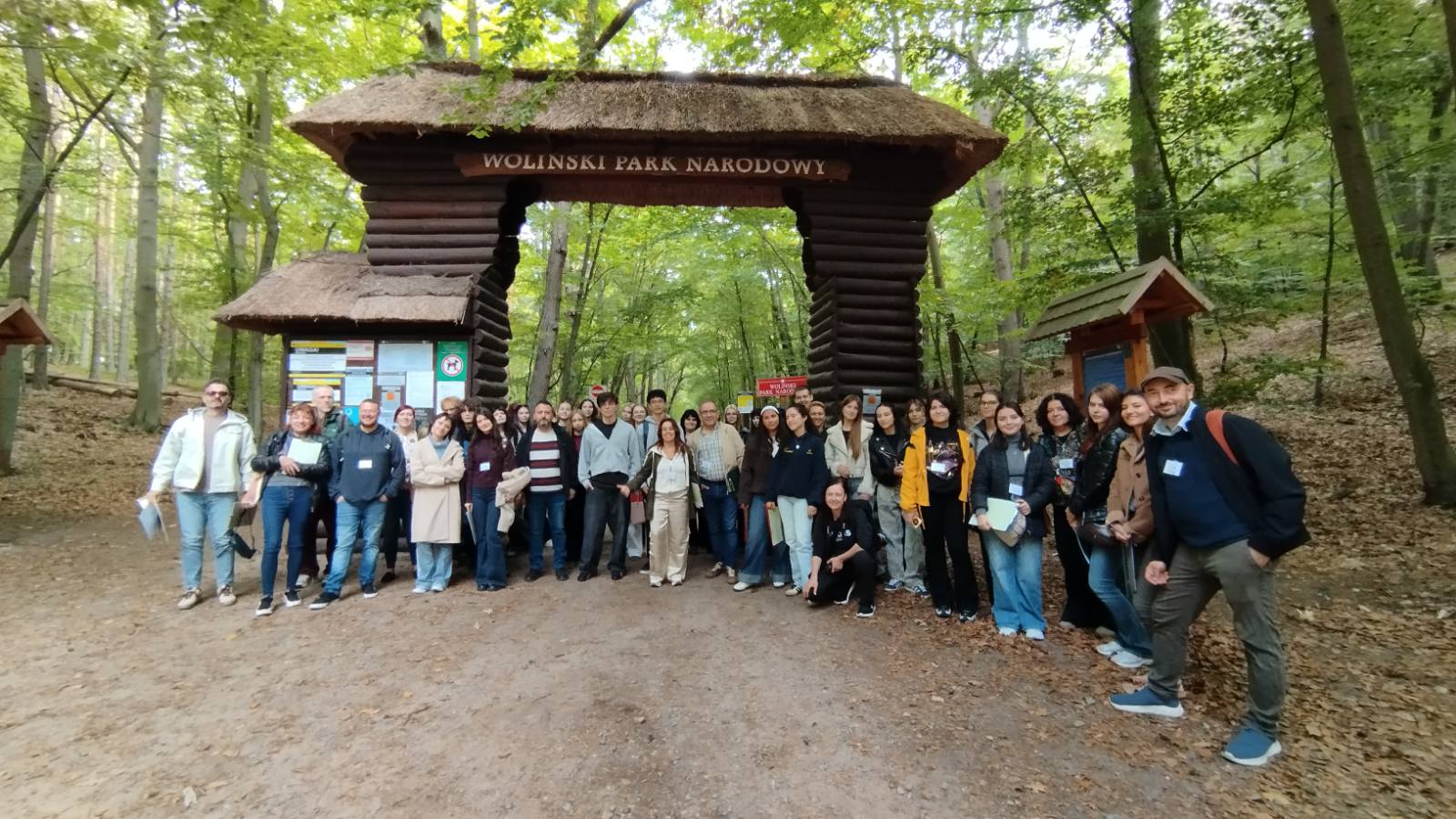
| Midday | Wolin National Park: Tour and Workshops |
| Afternoon | Walk by the sea |
| 14:30 – 16:00 | Lunch (25 euros per participant) |
| 16:00 – 17:00 | Free time in Międzyzdroje |
| 19:00 | Return to Szczecin |
Wolin National Park: A Living Classroom
Wolin National Park (Woliński Park Narodowy) was established in 1960 and covers 109.37 km² on Wolin Island, Poland’s largest island . The park is distinguished by:
- The most beautiful section of Poland’s cliff coastline
- Beech forests and mixed woodland (beech, oak, pine)
- The island delta of the Świna River
- Coastal waters of the Baltic Sea (one nautical mile)
The park’s symbol is the white-tailed eagle (bielik) – Poland’s largest nesting raptor – which can be observed alongside the park’s natural history museum .
Biodiversity Highlights:
- Up to 200 species of waterfowl, wading birds, and forest birds recorded
- Approximately 1,300 species of vascular plants
- European bison reserve (approximately 10 individuals)
- Orchids, royal ferns, and coastal plant species
Educational Workshops
The programme included structured environmental workshops on climate change and conservation, delivered within the park. These workshops directly supported the project’s objective of raising awareness regarding renewable energy and sustainable materials while providing practical examples of how environmental challenges can be addressed through education.
Walk by the Sea
A coastal walk along the Baltic shoreline provided participants with direct sensory engagement with the marine environment. For students from Greece, accustomed to the Mediterranean Sea, the colder, wilder Baltic represented a fundamentally different ecosystem – reinforcing the project’s principle that sustainability requires understanding all European environments.
Student Diaries & Reflection
Students documented their observations of the park’s ecosystems, reflecting on the contrast between the Baltic and Mediterranean environments, and the importance of protected natural areas.
📅 Day 3 Report | Wednesday, 30 September 2026
Programme Deliverable: A.3.2 Student Mobility in Poland – Heritage & Contemporary Art
Morning Session | Workshops: Ceramics & Calligraphy
| Time | Activity |
|---|---|
| 10:00 – 14:00 | Workshops for teens: Ceramics / Calligraphy (two rotating groups) |
| 14:00 – 15:00 | Lunch |
🏺 Ceramics Workshop
Students worked with clay – a natural, sustainable material – exploring form, volume, and the meditative rhythm of hand-building. For Greek participants, the workshop resonated with their own cultural heritage of ancient pottery traditions.
✍️ Calligraphy Workshop
The art of beautiful writing was introduced, developing patience, precision, and appreciation for the tactile, non-digital creative process. In an era of digital saturation, this workshop reinforced the value of slow, mindful making.
Afternoon Session | Archcathedral Basilica of St. James the Apostle
| Time | Activity |
|---|---|
| 15:30 | Visit to the Archcathedral Basilica and tower |
The Archcathedral Basilica of St. James the Apostle is the tallest church in Western Pomerania at 110.18 metres and the second-tallest in Poland. Its origins trace to the 12th century, and its history includes destruction by fire in the 17th century and heavy bombardment during World War II, followed by successive reconstructions .
Participants ascended to the observation terrace at 56 metres, accessed via modern lifts, where they were rewarded with panoramic views of Szczecin, the Oder River, and the surrounding forests and waterways.
This visit provided a powerful lesson in heritage preservation as a form of sustainability – the careful stewardship of cultural and architectural resources across generations.
Evening Session | TRAFO Gallery – KENBO Exhibition
| Time | Activity |
|---|---|
| 15:30 | Visit to Trafo Gallery – KENBO Exhibition (Liang Guojian) |
The day concluded at TRAFO Trafostacja Sztuki, a former power station transformed into one of Poland’s leading centres for contemporary art. The venue itself embodies the project’s ethos of reuse, transformation, and creative reinvention.
The delegation visited the exhibition of Chinese artist KENBO (Liang Guojian), whose multidisciplinary practice encompasses experimental ink painting, installation, video, and sound. The exhibition – structured around the four Mandarin tones of “ā á ǎ à” – operates as a meditation on language, migration, memory, and cultural translation.
For ARTisGReen participants, the exhibition demonstrated how contemporary art engages with themes of identity, displacement, and environmental consciousness – themes resonating with the project’s objectives around inclusion and resilience.
Student Diaries & Reflection
Students reflected on the juxtaposition of traditional craft (ceramics, calligraphy) with contemporary art (KENBO), and the role of heritage preservation in sustainability.
📅 Day 4 Report | Thursday, 1 October 2026
Programme Deliverable: A.3.2 Student Mobility in Poland – Green Architecture & Creative Synthesis
Morning Session | Visit to the Marshal’s Office
| Time | Activity |
|---|---|
| 08:45 – 11:00 | Trip to the Marshal’s Office |
| 11:30 – 12:30 | Free time |
| 13:00 – 15:30 | Workshops for youth |
The day commenced with a visit to the Marshal’s Office of the West Pomeranian Voivodeship (Urząd Marszałkowski Województwa Zachodniopomorskiego) – one of the most eco-friendly buildings in Poland.
Designed as a demonstration passive house, the building represents a tangible commitment to sustainable architecture. Participants learned how passive design principles – including optimised thermal envelopes, natural ventilation, and renewable energy integration – can reduce operational carbon footprints while maintaining functional excellence.
For the ARTisGReen delegation, this visit provided a real-world case study in how institutions can translate sustainability policy into architectural practice.
Afternoon Session | Youth Workshops (Part 2) & Teacher Workshop
| Time | Activity |
|---|---|
| 13:00 – 15:30 | Youth Workshops: Bioplastics / Cyanotype / Linocut (Part 2) |
| 13:00 – 15:30 | Teacher Workshop: “Inclusivity as a Strength” |
For Students:
The second instalment of the creative workshop series allowed participants to advance their skills in:
- Bioplastics – refining techniques for sustainable material production
- Cyanotype – deepening understanding of the historic photographic process
- Linocut – mastering carving techniques and composition
For Teachers:
A dedicated workshop session focused on inclusive teaching methodologies, providing educators with frameworks for supporting diverse learners in artistic education. This aligned with ARTisGReen’s explicit objective to increase participation of students from vulnerable groups in eco-friendly activities by 50% .
The parallel structure – students and teachers learning simultaneously, each according to their needs – exemplified the project’s commitment to lifelong learning and dual-target professional development.
Evening Session | International Evening
| Time | Activity |
|---|---|
| 18:00 – 20:00 | International Evening at the school |
The International Evening transformed the school into a vibrant celebration of cultural diversity. Participants from all six partner nations shared:
- Traditional cuisine – homemade specialties representing each country’s culinary heritage
- Music – rhythms and melodies that transcended language barriers
- Dance – traditional steps taught and shared with enthusiasm
- Stories – conversations that deepened friendships forged over four days of collaboration
The evening embodied the Erasmus+ priority of promoting active citizenship and intercultural dialogue.
Student Diaries & Reflection
Students reflected on the concept of inclusive education, the importance of passive architecture, and the cultural exchange experienced during the International Evening.
📅 Day 5 Report | Friday, 2 October 2026
Programme Deliverable: A.3.2 Student Mobility in Poland – Closing & Dissemination Planning
Morning Session | Eco Generator – Thermal Waste Treatment Facility
| Time | Activity |
|---|---|
| 08:00 | Departure for Eco Generator |
| 09:00 – 12:00 | Tour of the facility |
The final day commenced with a visit to the Eco Generator (Zakład Termicznego Unieszkodliwiania Odpadów) in Szczecin – one of Poland’s most advanced Thermal Waste Treatment and Energy Recovery Facilities.
The facility processes municipal waste to generate electricity and heat for the city. Participants received a presentation and guided tour, learning how:
- Waste is thermally treated through processes meeting Best Available Techniques (BAT) standards
- Steam from combustion powers turbine-generator sets, producing electricity for the grid
- Flue gas treatment includes advanced systems for emissions control
- The facility’s educational pathway demonstrates how waste-to-energy contributes to circular economy principles
For the Greek delegation, this visit offered a concrete model of how technology and environmental responsibility can coexist .
Midday Session | Lunch & Maritime Science Center
| Time | Activity |
|---|---|
| 12:00 – 13:00 | Lunch break |
| 13:00 – 15:00 | Visit to the Maritime Science Center |
The Maritime Science Center (Morskie Centrum Nauki im. prof. Jerzego Stelmacha) is a modern educational institution dedicated to popularising science through interactive exhibits. Opened in May 2023, the centre features over 200 interactive exhibits exploring physics, astronomy, ecology, geography, and maritime technology through the unifying theme of the sea .
The Centre holds a LEED Gold certification – the first cultural institution in the region to achieve this standard – reflecting its commitment to environmental sustainability .
Participants explored interactive exhibits on oceanography, navigation, marine biology, and science communication, demonstrating how curiosity and creativity can make complex scientific concepts accessible.
Afternoon Session | Project Wrap-Up & Certificate Ceremony
| Time | Activity |
|---|---|
| 16:00 | Project wrap-up, presentation of certificates |
The mobility concluded with an official wrap-up session, where:
- Project outcomes were reviewed, including progress on the Green Plan – the partnership’s shared sustainability roadmap
- Participants shared reflections on their learning journey across the five days
- Partners reaffirmed their commitment to the ARTisGReen mission
- Certificates of participation were presented to all students and teachers
For the Greek delegation, the ceremony marked the culmination of a week that had strengthened existing partnerships and deepened bonds between students from six European countries.
Teachers’ Meeting | Erasmus Days Dissemination Planning
During the final day, trainers and teachers from all partner organisations held a dedicated meeting to discuss the dissemination of ARTisGReen outcomes within their home institutions and local communities.
A key focus of discussion was the organisation of dissemination events during Erasmus Days 2026, scheduled for 12–17 October 2026 . Erasmus Days represent Europe’s largest celebration of the Erasmus+ programme, providing a platform for participants to share experiences and showcase project results.
The teachers explored potential formats including:
- School-based exhibitions of ARTisGReen products (eco-jewellery, ceramics, upcycled objects)
- Presentations to local educational communities and stakeholders
- Interactive workshops demonstrating bioplastics, cyanotype, and linocut techniques
- Online exchanges with partner schools to share experiences
This initiative reflected ARTisGReen’s commitment to sustainability beyond the project timeline – ensuring that knowledge, skills, and partnerships continue to benefit students, teachers, and communities across Europe.
Student Diaries & Final Reflection
Students completed their final diary entries, reflecting on the week’s experiences, the skills acquired, and their personal commitments to sustainability.
📊 Results and Outcomes
Tangible Results
The Polish mobility generated the following tangible outcomes:
| Category | Outcomes |
|---|---|
| Green Plan | Advanced and finalised – shared sustainability roadmap for all partner organisations |
| Creative Products | Bioplastics samples, cyanotype prints, linocut prints, ceramic objects, calligraphy works |
| Dissemination Plan | Erasmus Days 2026 events planned across partner schools |
| Documentation | Daily social media posts, photo/video documentation, student diaries |
Intangible Results
- Increased environmental awareness among participants regarding waste-to-energy, passive architecture, and biodiversity conservation
- Improved creative skills in bioplastics, cyanotype, linocut, ceramics, and calligraphy
- Strengthened inclusive teaching competences through dedicated teacher workshops
- Enhanced intercultural understanding and European citizenship
- Deepened cooperation among partner organisations
🎯 Contribution to Project Objectives
| Objective | Polish Mobility Contribution |
|---|---|
| O1 – Sustainability integration | Green Plan finalisation; passive house visit; waste-to-energy facility tour |
| O2 – Key competencies | Advanced workshops in sustainable artistic techniques; teacher training on inclusivity |
| O3 – Interdisciplinary STEAM methods | Integration of architecture, science, heritage, and contemporary art into coherent learning arc |
| O4 – Vulnerable group involvement | Inclusive workshop structure; accessible programme; teacher workshop on inclusive pedagogy |
📢 Dissemination Activities
Dissemination activities implemented during and following the Polish mobility included:
- Daily social media posts documenting activities and outcomes across RTIS Network, 4th Lyceum of Alimos, and partner channels
- Photo and video documentation for project archives and future dissemination
- Public exhibition of products at the host school
- Certificate ceremony with participation from local educational stakeholders
- Erasmus Days 2026 planning – dissemination events scheduled for 12–17 October 2026
🔗 Relevant Links
- ARTisGReen Project | Erasmus+ KA220-SCH Cooperation Partnership: European School Education Platform
- ARTisGReen | RTIS Network Project Page: rtisnetwork.org
- Erasmus+ Programme | EU Funding for Education: erasmus-plus.ec.europa.eu
- Erasmus Days 2026 | 12–17 October: erasmus-plus.ec.europa.eu/whats-new/erasmus-days
- Liceum Plastyczne im. Constantina Brancusiego | Host School: gov.pl/web/plastykszczecin
- Wolin National Park | Official Website: wopn.gov.pl
- Eco Generator | Official Website: ecogenerator.eu
- Maritime Science Center | Official Website: centrumnauki.eu
- 4th Lyceum of Alimos | Partner School: 4lykeioalimou.gr
- RTIS Network | Official Website: rtisnetwork.org
🔑 Focus Keywords
ARTisGReen | Erasmus+ KA220-SCH | 4th Transnational Meeting Poland | Szczecin | Wolin National Park | RTIS Network | Erasmus Days 2026
🏷️ Hashtags
#ARTisGReen #RTISNetwork #4thLyceumOfAlimos #ErasmusPlus #KA220SCH #Szczecin #Poland #4thMobility #GreenPlan #Sustainability #EcoCreativity #WolinNationalPark #EcoGenerator #MaritimeScienceCenter #ErasmusDays2026 #InternationalCollaboration #ErasmusFamily #EducationForSustainableDevelopment